Monday Morning Operator Checks That Prevent Silent Drift
After a stabilization project, the real test is Monday morning. Operators don't run 40-page runbooks under pressure. They run a handful of checks that are fast, repeatable, and actionable. Those checks prevent silent regression, which is the core of drift control and infrastructure stabilization. If your team doesn't have these checks in place, a health check is the fastest way to establish them.
Outcome: A prioritized, 10-minute checklist that surfaces drift and silent failures before the week begins.
Monday morning, the operator way
There's a particular moment on Monday morning that only operators really recognize. It exists as that quiet window before the week asserts itself, rather than an alert or a ticket: you finally get to ask a simple, dangerous question:
Did anything drift while nobody was looking?
Monday is the cheapest moment to notice drift before it collides with change windows and deployments.
What Monday checks actually are
Despite what tooling vendors imply, Monday-morning checks are not a checklist you can download. There's no universal list. The check is the first human checkpoint after a quiet stretch. It exists to surface exceptions, not to explain them.
Why long runbooks fail under pressure
Runbooks are not the problem. Unbounded runbooks are. Over time, they grow by accumulation: every incident leaves a scar, and every exception becomes a paragraph. Eventually, the runbook stops being an operational tool and becomes a historical document.
Shallow, by design
A good Monday-morning check is intentionally shallow. If it requires deep analysis, historical forensics, or a meeting, it doesn't belong here. This is not the time for architecture reviews or capacity planning.
Think of it as the operational equivalent of a pilot's walk-around. You're not disassembling the aircraft. You're looking for the things that shouldn't be true before you take off.
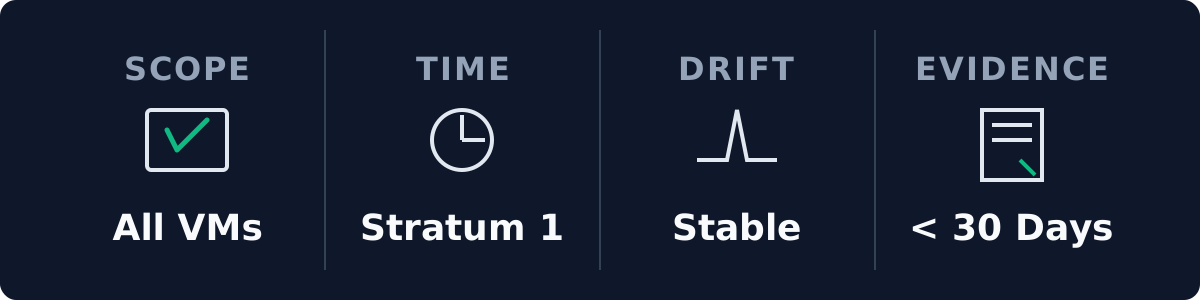
The Monday pass is shallow by design: a small set of checks that surface drift before it becomes a week-long incident.
The Monday list (minimum viable)
- Backup coverage exceptions. Verify if any production workloads are unprotected, rather than simply checking if jobs are green. Coverage gaps are the most common silent failure.
- Snapshot age. Snapshots older than a small threshold (days, not months) are performance debt and recovery risk disguised as convenience.
- Capacity drift. A datastore or volume that is filling faster than usual is a leading indicator. You want the slope, not the percentage.
- Host health exceptions. Hardware warnings, storage path flaps, degraded links. Exceptions only.
- Time discipline (identity-adjacent). If authentication has ever felt "random," include an NTP drift check for identity-critical systems.
- Restore test freshness. "Do we have recent proof for tier-1 systems?" A restore test older than the cadence is stale evidence.
Silent regression is the enemy
Most environments don't fail explosively. They degrade quietly, in the places that don't always alert. Monday checks work because they catch drift while it's still cheap.
Make the checks easy to run
- One screen. A single dashboard or a single email digest.
- Same format. Same order, same thresholds, every time.
- Exceptions only. Highlight only what changed rather than normal operations.
- Ten minutes. If it takes longer, it becomes optional.
If something is red
Every check should map to a short response path: acknowledge, capture evidence, and resolve or escalate.
- Unprotected workloads: fix scope, run an active full, schedule the next restore test.
- Old snapshots: coordinate a window, consolidate with validation, document the source so it doesn't repeat.
- Capacity slope change: identify the growth driver, confirm retention settings, act before it becomes an outage.
Operator-first Principle
Prioritize repeatable processes over impressive complexity. If Monday morning is calm, the system is actually stable.
Next step
Most engagements start with the Health Check. Fixed fee, clear picture, under two weeks.