The Abstraction Trap: Cisco UCS Policy Failures in the Field
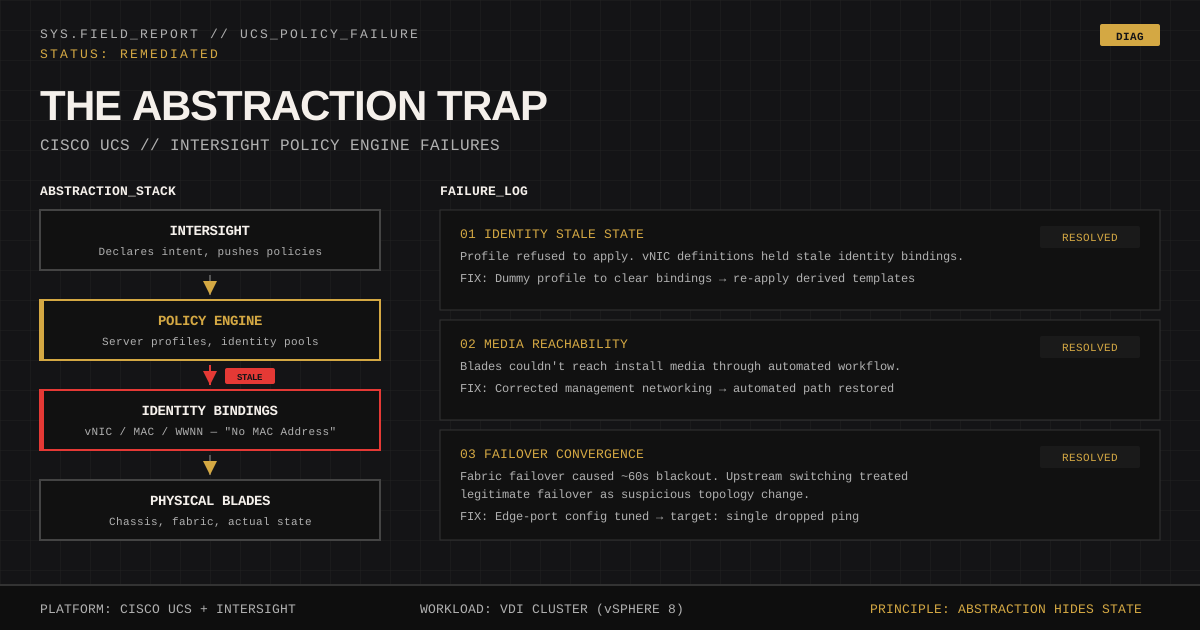

Policy engines promise a simple bargain: declare intent, and the platform does the wiring. When it works, you forget the hardware exists. When it doesn't, the hardware still has state, and now you're debugging it through a UI. This is the reality of brownfield infrastructure stabilization.
Outcome: Identity bindings reset, profiles re-applied, and failover validated against measured loss targets.
At a glance
Goal: Deploy a VDI cluster for a large institution using Cisco UCS and vSphere 8.
Constraint: Zero downtime migration from legacy hardware.
Reality: The "automated" tools failed at every critical juncture.
Engineering standards used
- Reversibility required for any migration step.
- Recovery paths documented before remediation (especially for policy engines).
- Failover tested and measured before acceptance.
- Version gaps treated as transfer risk, not an edge case.
- Automation verified at the hardware edge, not just in the UI.
1) When Logic Fights Physics
Cisco Intersight is designed to be the "brain" of the data center. It pushes policies to hardware so you don't have to configure servers manually.
In this deployment, the brain got confused in two ways:
First: the blades couldn't reliably reach or validate install media through the "automated" workflow. Once management networking was corrected, reachability snapped into place and the automated path became possible again.
Second: the policy engine refused to apply server profiles, flagging interfaces as having "No MAC Address" despite address pools being available. The system was stuck in a stale state, holding onto an identity that no longer matched the declared configuration.
The fix was not "try again harder." We forced a controlled reset: a temporary "dummy" profile to clear existing vNIC definitions and identity bindings, then re-applied the derived base templates.
Takeaway: Abstraction hides state rather than removing it, which eventually creates friction.
2) We Don't Gamble With Data
The industry default for migrating workloads between clusters is "magic button" migration. When it works, it's elegant. When it fails mid-transfer, it leaves partially moved data and an inconsistent inventory.
We chose the boring path instead. We attached the new storage to the old environment and moved VM data at the storage layer first. Only after the data was confirmed did we transition compute ownership.
Takeaway: A reversible migration plan is faster than a failed shortcut.
3) The 60-Second "Blip"
We built a redundant fabric: A side and B side, designed for instant failover. In testing, it wasn't.
During a controlled failover event, traffic went dark for roughly a minute. The upstream switching behavior served as the culprit, rather than the UCS hardware. Convergence and edge-port configuration treated legitimate failover like a suspicious new topology.
We didn't sign off until failover was measured, repeated, and improved. The acceptance target was: a single dropped ping during failover.
Takeaway: Redundancy requires measured loss rather than serving as a simple checkbox.
Engineering Principle
Verification lives at the hardware edge. Document recovery paths for policy failures, and test redundancy with measured loss. If your environment has grown beyond what your team can confidently map, a health check is the starting point.
Next step
Most engagements start with the Health Check. Fixed fee, clear picture, under two weeks.