Decision Note: The Broadcom Bill Just Landed. Now What?
March 2026 Update: Since this was published, the situation has gotten worse. The advice below still applies. As part of my VMware exit planning work, I have seen the math get even harder for operators.

VCSP program closed January 2026. All remaining transactions must complete by March 31, 2026.
Partner list gutted. Broadcom cut authorized partners from 4,500+ globally to as few as 19 in the US. CISPE estimates cumulative cost increases exceeding 1,000%.
Price increases hit 8x to 15x, up from the 3x that was common when this article was written.
Minimum core requirements jumped from 16 to 72 per license.
EU antitrust complaint filed. CISPE submitted a formal complaint against Broadcom to EU regulators on March 19, 2026.
I’ve seen the Reddit threads. I’ve seen the LinkedIn rants. More importantly, as someone who performs VMware exit planning, I’ve seen the invoices.
The Broadcom acquisition of VMware isn’t just industry gossip anymore; it’s a line item on your renewal quote. For many of you, that line item has tripled. Perpetual licenses are dead. "SnS" (Support and Subscription) is dead. You are being pushed into a subscription model, likely VMware Cloud Foundation (VCF), whether you need the full stack or not.
The natural reaction is anger. The second reaction is to yell, "We’re moving to Proxmox!"
I get it. But as an infrastructure architect who has to actually execute these moves, I need you to pause. Rage-migrating is expensive. Reversible migration engineering exists for a reason: you need a plan that lets you change course if the destination turns out worse than the origin. Before you tear out the foundation of your data center, let’s look at the actual physics of the situation.
The "Cheese Has Moved" (And It Cost You $50k)
First, accept the reality: Broadcom does not want small customers. If you are running three hosts in a closet, you are statistically irrelevant to their bottom line. They are optimizing for the Fortune 500 private cloud market.
This means you have three options, and none of them are perfect.
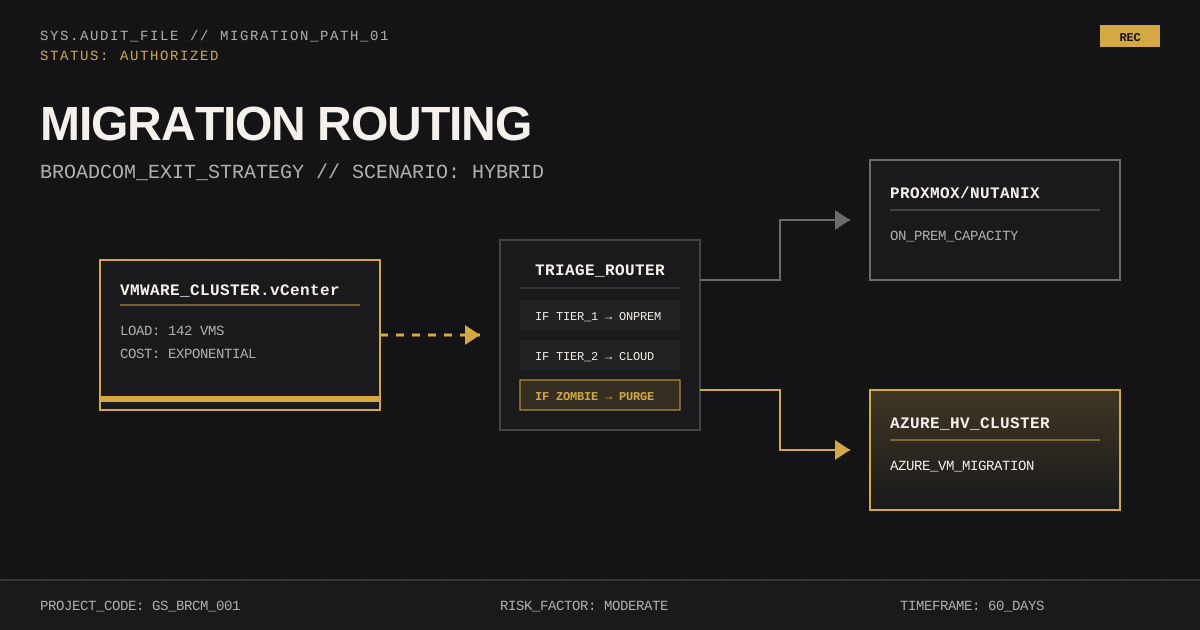
Option 1: The "Rage Quit" (Migration)
You want to leave. You want to go to Hyper-V, Nutanix, or Proxmox.
The Reality Check
Migration replaces licensing constraints with labor constraints.
- The Conversion Tax: Converting 200 VMs from VMDK to QCOW2 or VHDX takes time. It introduces risk. It requires maintenance windows.
- The Backup Gap: Does your backup solution (Veeam, Cohesity, Rubrik) support the new hypervisor with the same granularity? (Hint: Proxmox support is "emerging" for many vendors, not "enterprise mature.")
- The Skill Gap: Your team has spent 15 years learning vCenter. Do they know how to debug storage latency on KVM? If not, you are trading license costs for training costs (or outage risks).

Verdict: If your environment is simple (static workloads, low change rate), leave. If you rely on complex integrations, DR orchestration, or specific third-party ecosystem tools, the cost of leaving might be higher than the renewal.
Option 2: The "Lift and Shift" (Cloud)
"Fine, we'll just go to Azure/AWS."
The Trap
I wrote about this in my Migration Readiness notes: Migration tools work fine until they don’t. If you treat Azure like a colo facility, just lifting VMs and running them 24/7, your bill will make the Broadcom renewal look like a rounding error.
Cloud requires refactoring. If you aren't ready to rewrite apps or aggressively manage reserved instances, this accelerates financial risk rather than providing cost savings.
Option 3: The "Stay and Optimize" (The Boring Path)
This is the option nobody wants to talk about because it feels like losing. But often, it is the best engineering decision.
If you are forced to pay for VCF (which includes NSX, Aria/vRealize, and vSAN), you might as well use it to reduce other costs.
- Consolidate Hardware: Broadcom licenses by core. If you are running 5-year-old servers with low density, you are lighting money on fire. Refreshing hardware to high-density AMD EPYC chips can cut your core count (and license bill) in half.
- Kill the Zombies: I routinely find 15-30% of VMs are "zombies." Powered on but doing nothing, matching broader Flexera State of the Cloud waste estimates. Audit them. Delete them. Stop paying to license the cores they run on.
- Drop Third-Party Tools: If VCF gives you decent monitoring (Aria Operations) and network defense (NSX), do you still need that expensive SolarWinds or separate firewall maintenance contract?
The Generic Service Take
Don't make a six-figure infrastructure decision based on a five-minute emotional reaction.
- Get the Quote Early: Do not wait until 30 days before renewal. Broadcom creates friction; you need time to negotiate or plan.
- Do the Math: (License Cost Increase) vs. (Migration Hours × Hourly Rate + Risk + New Hardware).
- Optimize First: Before you leave, see if you can shrink your footprint.
If you’re staring at a renewal and don’t know if the math works, send me the numbers. I’ll tell you if you should stay or go. No sales pitch.
Start a Health Check
I help you make sense of the mess you have and decide whether to stay, migrate, or refactor. No hardware sales. No license sales. Just architecture.
Next step
Most engagements start with the Health Check. Fixed fee, clear picture, under two weeks.