strategy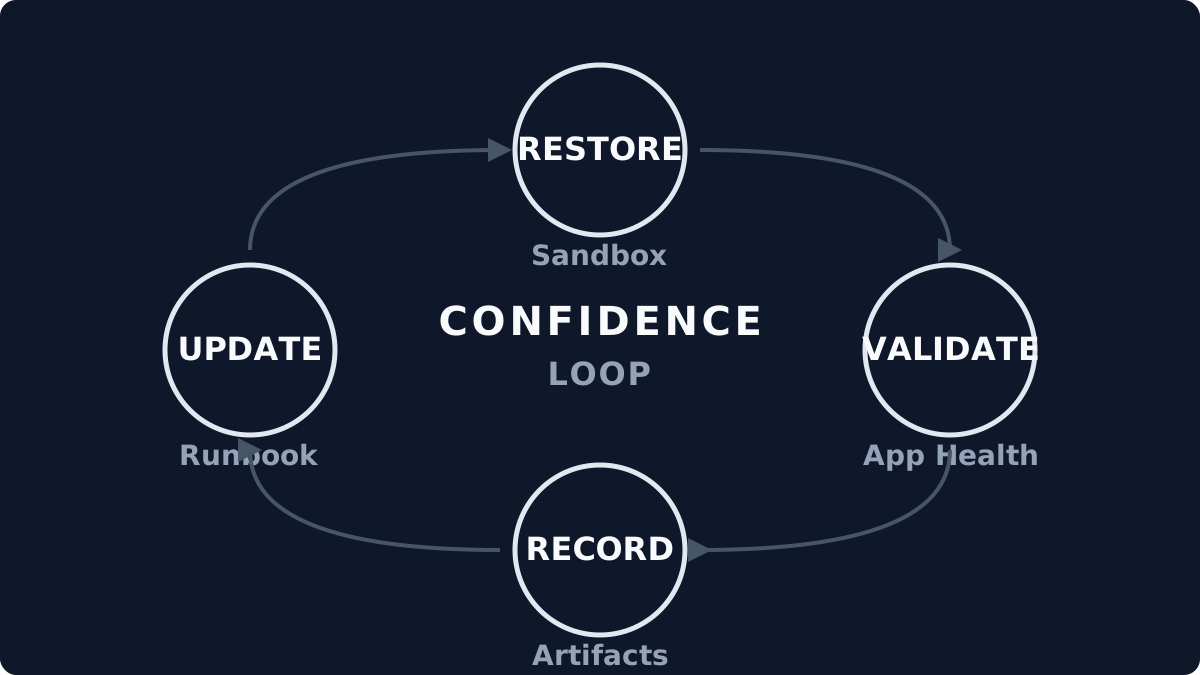
Restore Tests That Actually Prove Readiness
Backup reports are not evidence. Restore tests are. This is a practical baseline: small scope, measurable proof, and an operator-friendly cadence.
Outcome: A repeatable, 60-minute test procedure that validates data integrity and application functionality, not just file hydration.
What a restore test proves (and what it doesn't)
A restore test is not theater. It is a controlled rehearsal that produces timestamps and artifacts you can point to later.
- Proves: data can be recovered, booted, and validated within a defined window.
- Proves: the runbook is current, credentials work, and dependencies are understood.
- Does not prove: full disaster recovery for every workload. That is a separate exercise.
The 60-minute baseline test
The goal is repeatability. If the scope is too large, the test stops happening.
- Select one tier-1 workload and one tier-2 workload.
- Restore to an isolated sandbox network (no production routing).
- Boot, validate application health, and capture timings.
- Record restore duration vs. RTO, and data freshness vs. RPO.
- Capture evidence and close the loop with a short report.
Keep the loop short: restore, validate, record artifacts, and update the runbook on a predictable cadence.
Cadence by tier (minimum viable)
- Tier 1: monthly restore with evidence.
- Tier 2: quarterly restore with evidence.
- Tier 3: semi-annual spot check or backup verification sweep.
Evidence to capture
- Restore start and end timestamps (wall-clock and platform logs).
- Application validation steps and outcome (screenshots or logs).
- RPO/RTO comparison with a single sentence: met or missed.
- Runbook updates required (even if minor).
Common failure patterns
- Credentials rotated, runbook not updated.
- DNS or firewall rules missing in the sandbox.
- Backups are green but the app fails to start.
- RPO technically met, but data integrity checks fail.
What gets handed off
- One-page restore report per test (date, scope, timings).
- Updated runbook with known dependencies.
- Next test date and owner.
One-Page Restore Report (Template)Scope: System, environment, and restore point used.Timings: Restore start → app ready → validation complete.RPO / RTO: Targets vs. achieved, with one sentence: met or missed.Findings: Missing dependency, stale doc, or validation failure.
Stability PrincipleEvidence beats assurance. A green backup report is a claim. A restore test is proof.