strategy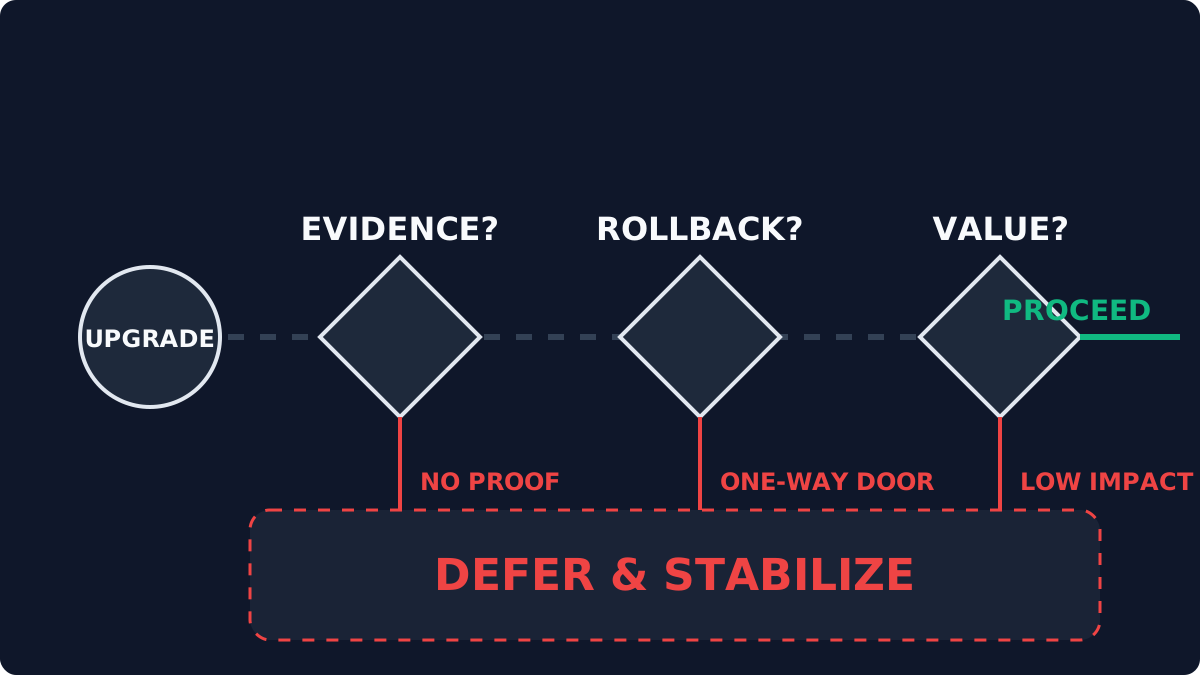
Decision Note: Deferring a Major Version Upgrade
We deferred a major platform upgrade after weighing recovery certainty, operational stability, and reversibility against the value of new features. > **Outcome:** Upgrade deferred, compensating controls implemented, restore-test cadence increased, and decision log updated. --- ## Context We evaluated a major version upgrade inside a core infrastructure layer: virtualization, storage firmware, or backup software. The release promised meaningful features and better alignment with the vendor roadmap, but it also introduced change across multiple surfaces at once: disk formats, management tooling, drivers, and recovery behavior. The existing platform is stable and predictable. ## Decision We chose to defer the upgrade. This is not a permanent refusal. It is a timing decision. We will revisit after additional validation, compatibility work, and a lower-risk change window. ## What we optimized for - Predictable maintenance windows with explicit validation steps. - Restore proof over feature promise. - Minimal blast radius per change.  Upgrade decisions move through explicit evidence gates. If rollback or recovery proof is weak, the default is defer with compensating controls. > **Decision Snapshot** > > - **Decision:** defer the major version upgrade. > - **Primary objective:** maintain reversibility and recovery certainty. > - **Tradeoff:** postpone non-essential features in favor of stability. ## Risks considered - **Recovery and rollback risk.** Major versions often change on-disk formats or metadata handling. Rollbacks can be destructive, not reversible. - **Operational continuity risk.** Upgrades require maintenance modes, evacuations, or service restarts. - **Compatibility risk.** Hypervisor, firmware, drivers, and storage paths move together. - **Backup integrity risk.** Backup software upgrades can alter formats, encryption, or retention logic. - **Operational response risk.** New versions change telemetry and error patterns, slowing triage. ## Evidence reviewed - Internal stability metrics were stable or improving. - Recent restore tests met RPO/RTO targets on current versions. - Vendor release notes included active caveats for the first patch cycle. - Compatibility matrices required staged remediation before upgrade. - Peer outcomes showed uneven stability until point releases arrived. - The upgrade window overlapped with higher-risk operational periods. ## Compensating controls implemented - Increased restore test frequency for tier-1 systems. - Applied security and stability patches within the existing major line. - Standardized settings across clusters and removed known sources of drift. - Documented rollback procedures and verified credential access. - Elevated monitoring for storage latency, backup success, and restore anomalies. ## Revisit criteria - Vendor point release reduces known-issue surface area. - Compatibility gaps are remediated across firmware and drivers. - Lab upgrade and rollback rehearsal completed successfully. - Two consecutive restore tests meet RPO/RTO under planned versions. - A lower-risk maintenance window is available. --- > **Operating Principle** > > **Stability before novelty.** A major upgrade is a one-way door unless you can prove the way back.